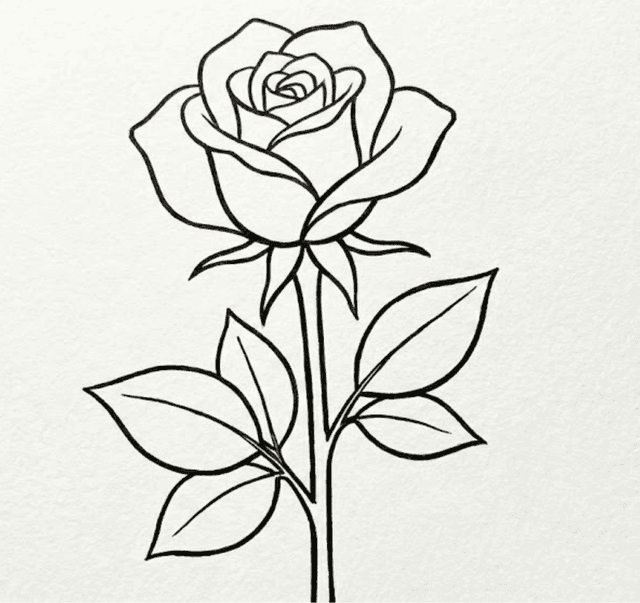
Ready to take your skills to the next level? This guide teaches you how to draw a realistic rose that looks like it could jump off the page. Learn how to draw a rose with pencil using professional shading techniques and detailed step-by-step instructions.
Introduction to Realistic Rose Drawing
Learning how to draw a realistic rose is different from simple sketching. When you master how to draw a rose with pencil realistically, you understand:
- Light and shadow principles
- Texture rendering
- Depth and dimension
- Tonal values
This tutorial on how to draw a rose step by step will elevate your artistry.
Materials for Realistic Rose Drawing
To draw a real rose effectively, you'll need quality materials:
- Pencils (HB, 2B, 4B, 6B): For various tones
- Drawing paper (smooth, heavy weight): For better detail
- Kneaded eraser (soft): For lifting highlights
- Blending stump (various sizes): For smooth gradients
- Reference photo (high quality): For accurate details
How to Draw a Realistic Rose: Understanding Structure
Before you draw a rose, study its anatomy:
Rose Petal Anatomy
- Outer petals: Larger, more curved, catch light
- Middle petals: Transition zone, medium tones
- Inner petals: Tighter, darker, more shadow
- Center: Darkest area, tight spiral
Light Behavior on Petals
Understanding light is crucial for how to draw a real rose:
- Light petals: Directly facing light source
- Mid-tones: Angled surfaces
- Shadows: Hidden areas, overlaps
- Reflected light: Light bouncing back into shadows
How to Draw a Rose Step by Step: Realistic Method
Step 1: Basic Structure Sketch
Begin your journey to draw a rose with a light sketch:
- Create a rough circular outline showing the overall rose shape
- Mark the center point
- Draw guidelines for major petals
- Keep lines VERY light - use HB pencil
Key point: This foundation determines everything. Take time to get proportions right.
Step 2: Define Petal Shapes
This step in how to draw a rose establishes form. Lightly sketch individual petal shapes, paying attention to:
- How petals overlap
- Their varying sizes
- Curved edges
- Natural asymmetry
When learning how to draw a rose with pencil, accuracy here saves time later.
Step 3: Establish Value Map
Before shading, plan your values. Using very light marks, indicate:
- Lightest areas (leave blank)
- Mid-tones (light hatching)
- Dark areas (slightly darker marks)
- Deepest shadows (darkest marks)
This is where how to draw a complicated rose differs from simple sketches.
Step 4: Begin Shading - Inner Petals
Start shading from the center to draw a realistic rose. Using 2B-4B pencils:
- Identify the darkest inner areas
- Apply smooth, even shading
- Follow the curve of each petal
- Build up layers gradually
Technique tip: For how to draw a rose with pencil, use circular motions for smooth blending.
Step 5: Develop Middle Petals
Continue to draw a rose step by step by moving outward to middle petals:
- Use lighter values than center
- Create smooth transitions
- Pay attention to edges
- Add subtle details
Step 6: Complete Outer Petals
The outer petals are crucial for a realistic rose. Outer petals typically:
- Have the lightest values
- Show the most detail
- Display subtle veining
- Catch highlights on edges
Step 7: Refine and Detail
This step makes your rose truly realistic. Add fine details:
- Subtle veins on petals
- Soft edge variations
- Tiny imperfections
- Delicate textures
Step 8: Final Touches
Complete your realistic rose:
- Adjust overall values
- Clean up edges
- Lift highlights with eraser
- Sign your work!
How to Draw a Rose with Pencil: Shading Techniques
Master these techniques to draw a rose realistically:
Technique 1: Layered Shading
Build up values gradually:
- Start with lightest tones
- Add medium tones
- Deepen shadows
- Refine transitions
Technique 2: Directional Strokes
Your pencil strokes should follow petal curves to create natural-looking results when you draw a rose with pencil.
Technique 3: Lifting Highlights
Use a kneaded eraser to:
- Create bright highlights
- Add subtle light variations
- Clean up edges
- Add texture
How to Draw a Complicated Rose: Advanced Tips
For those wanting to master how to draw a complicated rose:
Multiple Bloom Perspectives
Practice drawing roses from various angles:
- Full front view
- Three-quarter angle
- Side profile
- Top-down view
Complex Petal Arrangements
A complicated rose features:
- Many overlapping petals
- Varying petal sizes
- Natural imperfections
- Detailed texture throughout
How to Draw a Real Rose: Working from Reference
When learning how to draw a real rose, use quality references:
Choosing Good References
Look for photos with:
- Clear lighting (single light source)
- High resolution
- Visible detail
- Interesting angles
Analyzing Your Reference
Before you draw a rose, study:
- Light direction
- Value patterns
- Petal structure
- Overall proportions
Common Challenges in Realistic Rose Drawing
When learning how to draw a realistic rose, you may face these challenges:
- Muddy values: Clean hands, fresh paper
- Flat appearance: Increase value contrast
- Stiff petals: Use flowing, curved strokes
- Lost details: Work in stages, small to large
- Over-shading: Build up gradually
Step by Step How to Draw a Rose: Professional Workflow
Here's the complete step by step process to draw a rose professionally:
- Observation (5-10 min) - Study your reference thoroughly
- Light sketch (10-15 min) - Basic shapes and proportions
- Refine sketch (10-15 min) - Define petals and structure
- Value mapping (5-10 min) - Plan your lights and darks
- Initial shading (20-30 min) - Establish basic values
- Build depth (20-30 min) - Develop full tonal range
- Details (15-20 min) - Add fine textures and veins
- Final polish (10 min) - Refine and clean up
How to Draw a Rose: Pencil Selection Guide
Different pencils serve different purposes when you draw a rose with pencil:
- HB (Light): Initial sketching
- 2B (Medium-light): Light shadows
- 4B (Medium): Mid-tones
- 6B (Dark): Deep shadows
- 8B (Very dark): Darkest accents
Practice Exercises for Realistic Roses
To master how to draw a realistic rose:
Exercise 1: Petal Studies
Draw individual petals from different angles. Focus on shading and form.
Exercise 2: Value Scales
Create 10-step value scales to train your eye and hand.
Exercise 3: Sphere Shading
Practice on spheres to understand how light wraps around curved forms.
Exercise 4: Rose Copies
Copy master drawings of roses to learn techniques.
From Simple to Realistic: The Progression
Your journey in learning how to draw a rose:
- Beginner (Simple rose): Basic shapes, minimal shading
- Intermediate (Detailed rose): More petals, light shading
- Advanced (Realistic rose): Full values, fine details
- Master (Real rose): Photorealistic quality
Troubleshooting Your Realistic Rose
If your rose doesn't look realistic:
Problem: Looks Flat
Solution: Increase contrast between lights and darks
Problem: Too Dark Overall
Solution: Use lighter pencils, leave more white space
Problem: Petals Look Same
Solution: Vary values, sizes, and edge quality
Problem: Lacks Detail
Solution: Add subtle veins, texture, edge variations
Conclusion: Mastering How to Draw a Realistic Rose
Learning how to draw a realistic rose with pencil takes practice and patience. Remember:
- Start with accurate structure
- Build values gradually
- Follow petal curves with your strokes
- Pay attention to light and shadow
- Practice regularly
Whether you want to draw a real rose or create complicated rose compositions, these techniques will serve you well.
Continue Your Learning:
Keep pushing your artistic boundaries!